Why VPS Hosting Is More Secure Than Shared Hosting?
- December 24, 2025
- 1 Comment
Website security is no longer something you can ignore. Today, even small websites face hacking attempts, malware infections, spam attacks, and data theft. Whether you run a personal blog, an online store, a business website, or a growing application, security plays a major role in your success.
One of the biggest factors that affects your website’s security is the type of hosting you choose. Many people start with shared hosting because it is cheap and easy to use. While shared hosting can work for very basic websites, it often creates serious security risks as your website grows.
This is where VPS hosting becomes important. In this article, you will clearly understand why is VPS hosting more secure than shared hosting, how both hosting types work, what risks are involved, and why VPS hosting is considered a safer choice for modern websites.
Understanding Web Hosting Security
Before comparing shared hosting and VPS hosting, it is important to understand what hosting security actually means.
Hosting security refers to how well your server environment protects your website, files, databases, applications, and user data from threats. These threats can include hacking, malware, data breaches, unauthorized access, spam abuse, and server downtime.
A secure hosting environment helps you:
- Keep your website data safe
- Protect customer information
- Prevent website downtime
- Maintain trust with users
- Avoid search engine penalties
- Protect your brand reputation
The level of security you get depends heavily on how your hosting environment is set up.
What Is Shared Hosting?
Shared hosting is one of the most common hosting types, especially for beginners. In shared hosting, multiple websites are hosted on the same physical server and share the same resources.
This means:
- Many websites run on a single server
- CPU, RAM, and storage are shared
- All users use the same operating system
- Security settings apply to everyone on the server
- Individual users have very limited control
Shared hosting is affordable and easy to manage, but the shared environment introduces several security weaknesses that many users are not aware of.
What Is VPS Hosting?
VPS stands for Virtual Private Server. VPS hosting uses virtualization technology to divide one physical server into multiple independent virtual servers.
Each VPS behaves like a separate server with:
- Dedicated CPU resources
- Dedicated RAM
- Dedicated storage space
- Its own operating system
- Isolated file system
Even though multiple VPS servers exist on the same physical machine, they are completely separated from each other.
This separation is the foundation of VPS security.
Core Difference Between VPS and Shared Hosting Security
The biggest difference between shared hosting and VPS hosting is isolation.
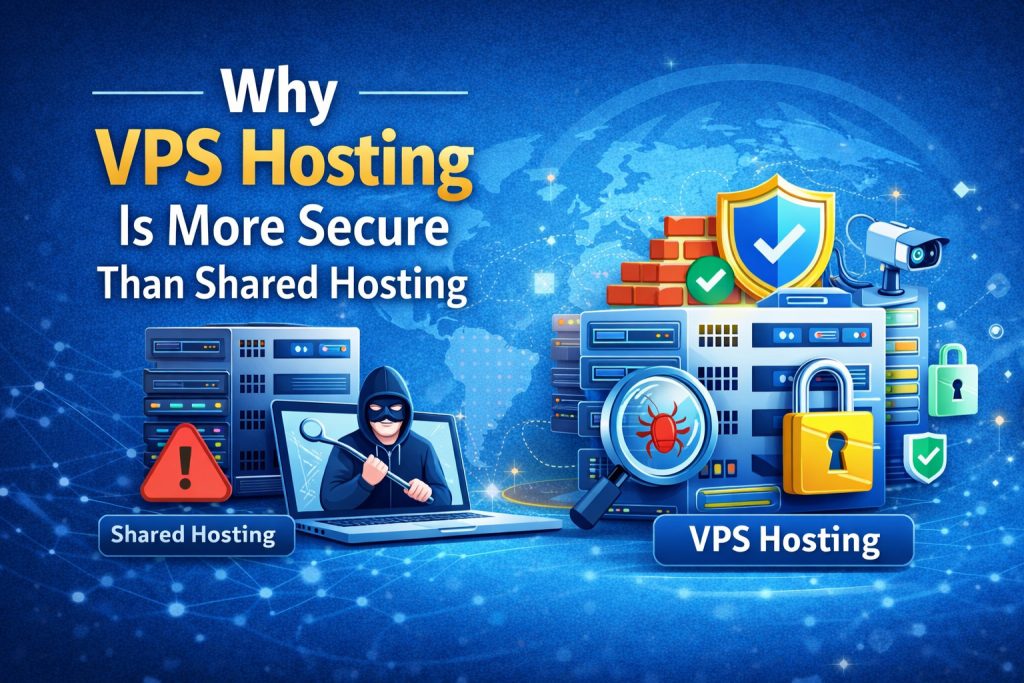
a) In shared hosting, all websites live in the same environment. If one website becomes vulnerable, other websites on the same server can also be affected.
b) In VPS hosting, each user is placed in a private virtual environment. Even if another VPS on the same server gets attacked, your VPS remains protected.
This single difference makes VPS hosting far more secure than shared hosting.
Why Is VPS Hosting More Secure Than Shared Hosting?
Let us now explore the main reasons why VPS hosting offers stronger security.
1. Strong Isolation Between Users
In shared hosting, all websites run under the same operating system. This means vulnerabilities in one website can expose other websites on the server.
With VPS hosting:
- Each VPS runs in its own isolated container
- Users cannot access each other’s files or processes
- Server level attacks are contained
This isolation prevents attackers from moving from one website to another.
2. Dedicated Resources Improve Stability and Security
Shared hosting divides server resources among many users. If one website uses too much CPU or RAM, it can slow down or crash other websites.
An overloaded server becomes an easy target for attackers.
VPS hosting provides:
- Guaranteed CPU allocation
- Dedicated memory
- Stable performance
Stable systems are harder to exploit, making VPS hosting safer.
3. Full Control Over Security Settings
Shared hosting users have almost no control over server security. You must rely on default configurations set by the hosting provider.
With VPS hosting, you have full control to:
- Configure firewalls
- Set security rules
- Manage open ports
- Install security tools
- Control access permissions
This flexibility allows you to protect your server based on your website’s needs.
4. Reduced Risk of Malware Spread
Malware infections are common in shared hosting environments. If one website is infected, malware can spread across the server.
VPS hosting prevents this because:
- File systems are separated
- Processes are isolated
- Malware cannot jump between VPS servers
This significantly reduces the risk of infection.
5. Better Protection Against Brute Force Attacks
Brute force attacks work by repeatedly trying different login combinations until the correct password is found.
On shared hosting:
- Security rules apply broadly
- Attackers can exploit weak accounts
On VPS hosting:
- You can set login limits
- Block suspicious IP addresses
- Enable intrusion detection
- Apply advanced authentication
This makes VPS hosting more resistant to unauthorized access.
6. Custom Firewall Configuration
Shared hosting firewalls are shared by everyone on the server. You cannot customize them for your specific application.
With VPS hosting, you can:
- Create custom firewall rules
- Allow or block specific ports
- Restrict traffic by region
- Apply application level security
Custom firewalls add an extra layer of protection.
7. Better Data Privacy and Compliance
Websites that handle user data, payments, or personal information require strong privacy protection.
VPS hosting supports:
- Isolated data storage
- Secure access controls
- Custom encryption
- Compliance friendly environments
Shared hosting often struggles with privacy standards because data is stored in shared environments.
8. Root Access Improves Security Management
VPS hosting provides root or administrator access. This allows you to:
- Install security patches instantly
- Remove vulnerable software
- Control user permissions
- Monitor server activity
Shared hosting does not offer this level of access.
9. Independent Software Updates
In shared hosting, updates affect all websites. Delays or compatibility issues can create security gaps.
With VPS hosting:
- You control when updates happen
- You choose secure software versions
- You avoid dependency on other users
Timely updates reduce vulnerabilities.
10. Lower Risk of IP Blacklisting
Shared hosting often uses the same IP address for many websites. If one website sends spam or hosts malicious content, the entire IP can get blacklisted.
VPS hosting offers:
- Dedicated IP addresses
- Clean reputation
- Better email deliverability
This protects your website’s credibility.
VPS vs Shared Hosting Security Comparison Table
| Sr. No. | Security Feature | Shared Hosting | VPS Hosting |
|---|---|---|---|
| 1 | User Isolation | No | Yes |
| 2 | Dedicated Resources | No | Yes |
| 3 | Firewall Control | Limited | Full |
| 4 | Malware Spread Risk | High | Very Low |
| 5 | Root Access | No | Yes |
| 6 | Custom Security Tools | Not Allowed | Allowed |
| 7 | IP Reputation | Shared | Dedicated |
| 8 | Data Privacy | Low | High |
| 9 | Attack Containment | Weak | Strong |
| 10 | Server Control | Very Limited | Complete |
Who Should Choose VPS Hosting for Security?
VPS hosting is ideal for:
- Ecommerce websites
- Business websites
- High traffic blogs
- SaaS platforms
- Agencies and developers
- Websites handling sensitive data
- Growing startups
If security and reliability matter, VPS hosting is the right choice.
Common Security Risks in Shared Hosting
Understanding shared hosting risks helps explain the benefits of VPS hosting.
1. Cross Website Attacks
Hackers exploit weak websites to gain access to server resources.
2. Resource Overuse
One compromised website can affect others.
3. Limited Security Control
Generic security rules cannot protect all websites.
4. Slow Threat Response
Users depend on the hosting provider for fixes.
How VPS Hosting Helps Reduce Downtime?
Security issues often lead to downtime.
VPS hosting reduces downtime by:
- Isolating failures
- Preventing resource abuse
- Allowing faster recovery
- Limiting attack impact
This is critical for business websites.
VPS Hosting and DDoS Protection:
DDoS attacks aim to overwhelm server resources.
VPS hosting supports:
- Traffic filtering
- Resource isolation
- Advanced monitoring
- Custom defense strategies
Shared hosting lacks flexibility to handle such attacks effectively.
VPS Security Best Practices:
To maximize VPS security:
- Use strong passwords
- Enable two factor authentication
- Update software regularly
- Monitor server logs
- Take frequent backups
- Limit user access
When combined with VPS hosting, these practices create a strong security foundation.
Why Businesses Prefer VPS Hosting?
Businesses choose VPS hosting because:
- Security risks are lower
- Performance remains stable
- Compliance is easier
- Control is higher
- Growth is supported
VPS hosting offers peace of mind.
FAQ’s – (Frequently Asked Questions)
Q1. Is VPS hosting completely secure
No hosting solution is completely secure, but VPS hosting is far more secure than shared hosting.
Q2. Can another VPS affect my server
No. VPS environments are isolated from each other.
Q3. Is VPS hosting suitable for beginners
Yes. Managed VPS hosting makes security easy for beginners.
Q4. Does VPS hosting include firewall protection
Yes. VPS hosting allows custom firewall configurations.
Q5. Is shared hosting unsafe
Shared hosting is not unsafe, but it carries higher risks for growing websites.
Q6. Is VPS hosting worth the cost
Yes. The added security, control, and reliability make VPS hosting a better long term investment.
Strengthen Your Website Security with VPS Hosting
Move beyond shared hosting and protect your website with VPS hosting. Get better security, dedicated resources, and full control with LunarVPS.
You Might Also Like This:
- How Much RAM and CPU Do You Really Need in a VPS?
- How VPS Hosting Improves Website Speed, Security & Reliability
Conclusion:
Website security should never be compromised to save money. While shared hosting may work for very small websites, it exposes users to unnecessary risks because of its shared environment.
VPS hosting provides isolation, dedicated resources, advanced security controls, and better privacy protection. These features make VPS hosting a far more secure option for modern websites.
If your website matters to you, upgrading to VPS hosting is not just an improvement. It is a smart and necessary step toward long term security and stability.
Get more stuff
Subscribe to our mailing list and get interesting stuff and updates to your email inbox.
Thank you for subscribing.
Something went wrong.
Latest Posts
Why VPS Hosting Is More Secure Than Shared Hosting?
How Much RAM and CPU Do You Really Need in a VPS?
How VPS Hosting Improves Website Speed, Security, and Reliability
DMCA Ignored VPS Hosting | LunarVPS
Comments
How VPS Hosting Improves Website Speed, Security, and Reliability – Blog | LunarVps
[…] Why VPS Hosting Is More Secure Than Shared Hosting? […]