Anonymous Hosting vs Traditional Hosting: Key Differences Explained
- January 5, 2026
- 2 Comments
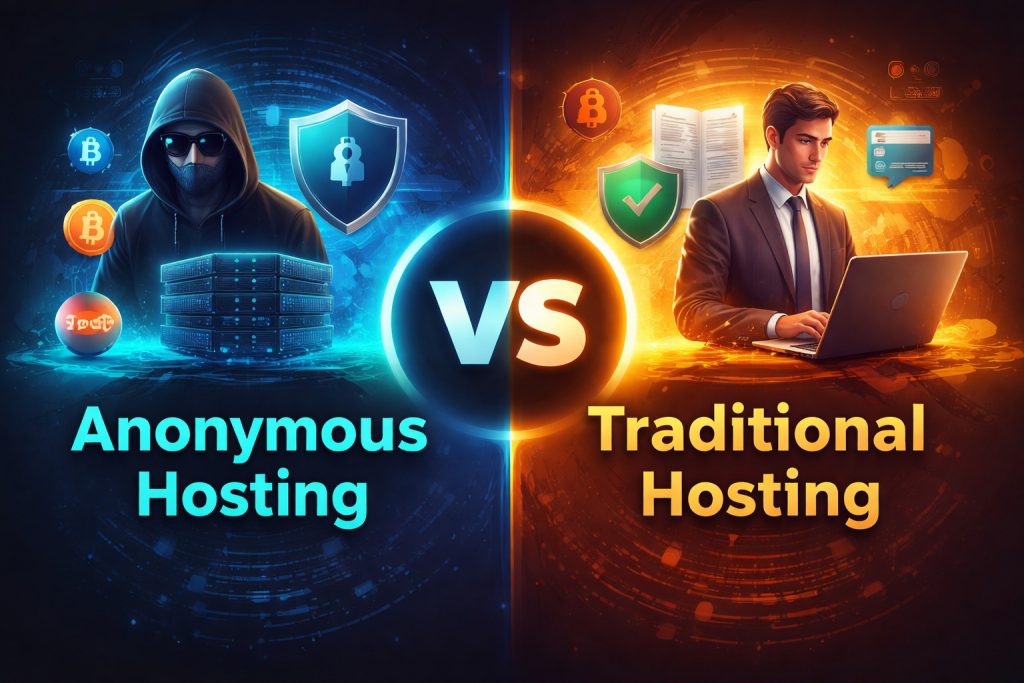
Every website, application, or online platform needs hosting. Hosting is the space where your website lives, runs, and stays accessible to users around the world. While many people choose hosting based on price or performance, another factor has become increasingly important in recent years, privacy.
Traditional hosting has been the default choice for a long time. It works well for many businesses and individuals, but it also involves sharing personal information, payment details, and identity verification. As online tracking, surveillance, and data misuse increase, many users are now questioning how much personal information they really need to share.
This is where anonymous hosting comes in. Anonymous hosting offers a way to host websites and applications with minimal identity exposure. It focuses on protecting user privacy while still providing reliable infrastructure.
In this article, we will clearly explain the difference between anonymous hosting and traditional hosting. You will understand how both work, their advantages, limitations, and which option is better for your specific needs.
What Is Traditional Hosting?
Traditional hosting refers to standard web hosting services offered by most mainstream providers. This includes shared hosting, VPS hosting, cloud servers, and dedicated servers that follow common registration and compliance processes.
When you sign up for traditional hosting, you are required to provide personal information. This usually includes your full name, email address, phone number, physical address, and payment details. These details are stored in the hosting provider’s system.
Traditional hosting companies often follow strict rules related to identity verification and data storage. They may also log user activity for security, billing, and compliance purposes.
For businesses that need transparency, official documentation, and easy integrations, traditional hosting is often the most convenient option.
What Is Anonymous Hosting?
Anonymous hosting is designed for users who want to keep their identity private while hosting websites or applications. The main goal is to reduce personal data exposure as much as possible.
With anonymous hosting, users can usually sign up without providing real names or physical addresses. Payments are often accepted through cryptocurrency or privacy focused payment methods.
Anonymous hosting does not mean ignoring laws or rules. Reputable providers still maintain acceptable use policies. The difference is that they collect less personal data and avoid unnecessary tracking.
This type of hosting is popular among developers, journalists, researchers, and privacy conscious individuals.
Why Online Privacy Has Become More Important?
In today’s digital world, personal data is constantly collected, stored, and shared. Hosting accounts often contain sensitive information that can be linked directly to websites, server activity, and online behavior.
Traditional hosting creates a clear connection between a person and their server. This can be risky in certain situations, especially when dealing with sensitive projects or confidential information.
Anonymous hosting helps reduce this risk. By limiting personal data collection, it provides an additional layer of protection against tracking and unwanted exposure.
For many users, privacy is no longer optional. It is a necessity.
Core Differences Between Anonymous Hosting and Traditional Hosting
The most important differences between anonymous hosting and traditional hosting revolve around identity, data handling, and privacy policies.
| Sr. No. | Feature | Anonymous Hosting | Traditional Hosting |
|---|---|---|---|
| 1 | Personal Information | Minimal or none | Full personal details required |
| 2 | Payment Options | Cryptocurrency or privacy methods | Cards, banks, online gateways |
| 3 | Data Storage | Limited data collection | Extensive user data stored |
| 4 | Privacy | Extremely High | Low To Moderate |
| 5 | Level of Tracking | Low | Common practice |
| 6 | Compliance Approach | Privacy focused | Regulation focused |
| 7 | Ideal Users | Privacy sensitive users | General businesses |
This table highlights how the two hosting models differ in purpose and approach.
Account Registration Process
1. Traditional Hosting Registration
Traditional hosting providers require full account creation. Users must verify email addresses and complete payments through traceable methods. This creates a permanent record linking the account to an individual or company.
This process improves accountability but reduces anonymity.
2. Anonymous Hosting Registration
Anonymous hosting simplifies registration. Many providers allow signups using only an email address or a randomly generated account ID.
Payments are completed using cryptocurrency, which reduces the link between personal identity and hosting activity.
Payment Privacy and Financial Tracking
Payment methods reveal a lot about users.
- Traditional hosting payments pass through banks and payment processors. These entities store transaction data and may share it with other parties.
2. Anonymous hosting supports cryptocurrency payments that do not require personal identification. This offers better financial privacy.
For users who want to keep business operations discreet, this is a significant advantage.
Data Logging and Monitoring Practices
- Traditional hosting providers often maintain detailed logs. These may include login times, IP addresses, usage patterns, and account changes.
2. Anonymous hosting providers aim to reduce logging. Many follow low log or no log policies, collecting only what is necessary for service operation.
While no system can be completely log free, anonymous hosting significantly limits unnecessary data collection.
Security in Anonymous vs Traditional Hosting
Security is important in both hosting types.
- Traditional hosting relies heavily on monitoring, logging, and identity verification. This can help with fraud prevention but also increases data storage.
2. Anonymous hosting focuses on infrastructure security rather than user monitoring. Firewalls, server hardening, and DDoS protection are implemented without excessive user tracking.
When managed properly, both hosting types can be secure.
Performance and Uptime Comparison
A common misunderstanding is that anonymous hosting is slower. In reality, performance depends on server hardware, network quality, and data center infrastructure.
High quality anonymous hosting providers offer SSD storage, powerful CPUs, and reliable network connections.
The difference lies in privacy policies, not performance levels.
Legal and Responsible Usage
Anonymous hosting is legal in many countries when used responsibly. Providers still enforce rules against harmful or illegal content.
Anonymous does not mean unregulated. Ethical hosting companies balance privacy with legal responsibilities.
Users should always follow laws applicable to their location and use hosting services responsibly.
When Traditional Hosting Makes Sense
Traditional hosting is suitable for:
- Registered companies
- Online stores
- Corporate websites
- Government or compliance heavy projects
- Users who value simplicity
If transparency and mainstream integrations are priorities, traditional hosting works well.
When Anonymous Hosting Is the Better Choice
Anonymous hosting is ideal for:
- Privacy focused individuals
- Developers working on sensitive projects
- Journalists and researchers
- Activists and advocacy groups
- Users who want minimal data exposure
It offers freedom and control over personal information.
Anonymous VPS Hosting Explained
Anonymous VPS hosting provides dedicated server resources with privacy protection. Users get full control without exposing identity.
This makes it suitable for applications, backend systems, private websites, and testing environments.
Platforms like lunarvps.com focus on combining performance with privacy friendly policies.
Clearing Common Myths About Anonymous Hosting
Many people wrongly assume anonymous hosting is used only for illegal purposes. In reality, most users choose it for safety and confidentiality.
Another myth is poor reliability. With the right provider, anonymous hosting delivers strong uptime and speed.
Understanding these facts helps users make informed choices.
How to Choose the Right Hosting Type?
Choosing between anonymous and traditional hosting depends on priorities.
- If official documentation and convenience matter most, traditional hosting is suitable.
- If privacy, reduced tracking, and identity protection are important, anonymous hosting is the better option.
The right choice depends on how much control you want over your data.
FAQ’s – (Frequently Asked Questions)
Q1. Is anonymous hosting legal?
Yes, it is legal in many regions when used for lawful purposes.
Q2. Will anonymous hosting slow down my website?
No, performance depends on infrastructure quality.
Q3. Can startups use anonymous hosting?
Yes, especially for testing, development, and privacy sensitive operations.
Q4. Is anonymous hosting fully untraceable?
No system is completely untraceable, but it greatly reduces exposure.
Q5. Is anonymous hosting secure?
Yes, when provided by reliable hosting companies.
You Might Also Like This:
- How to Optimize Performance on Offshore VPS Servers: A Complete Guide
- How to Choose Best Offshore VPS for Your Business
- How Server Performance Directly Impacts User Experience
Conclusion:
Anonymous hosting and traditional hosting serve different purposes. Traditional hosting focuses on convenience, compliance, and transparency. Anonymous hosting focuses on privacy, data minimization, and identity protection.
As online privacy concerns continue to grow, anonymous hosting has become a practical and responsible choice for many users. It allows individuals and businesses to host projects without unnecessary personal risk.
For users who want both performance and privacy, platforms like lunarvps.com offer solutions designed for the modern internet. Choosing the right hosting type is about understanding your needs and protecting your digital presence wisely.
Get more stuff
Subscribe to our mailing list and get interesting stuff and updates to your email inbox.
Thank you for subscribing.
Something went wrong.
Latest Posts

How Server Performance Directly Impacts User Experience


How to Choose the Best Offshore VPS for Your Business in 2026

Comments
How to Optimize Performance on Offshore VPS Servers: A Complete Practical Guide – Blog | LunarVps
[…] Anonymous Hosting vs Traditional Hosting: Key Differences Explained […]
How Server Performance Directly Impacts User Experience – Blog | LunarVps
[…] Anonymous Hosting vs Traditional Hosting: Major Differences Explained […]